Abstract:Perry Warjiyo resigned as Bank Indonesia governor, Destry Damayanti became acting governor, and the rupiah traded above Rp18,000. Here is what forex traders should monitor next.
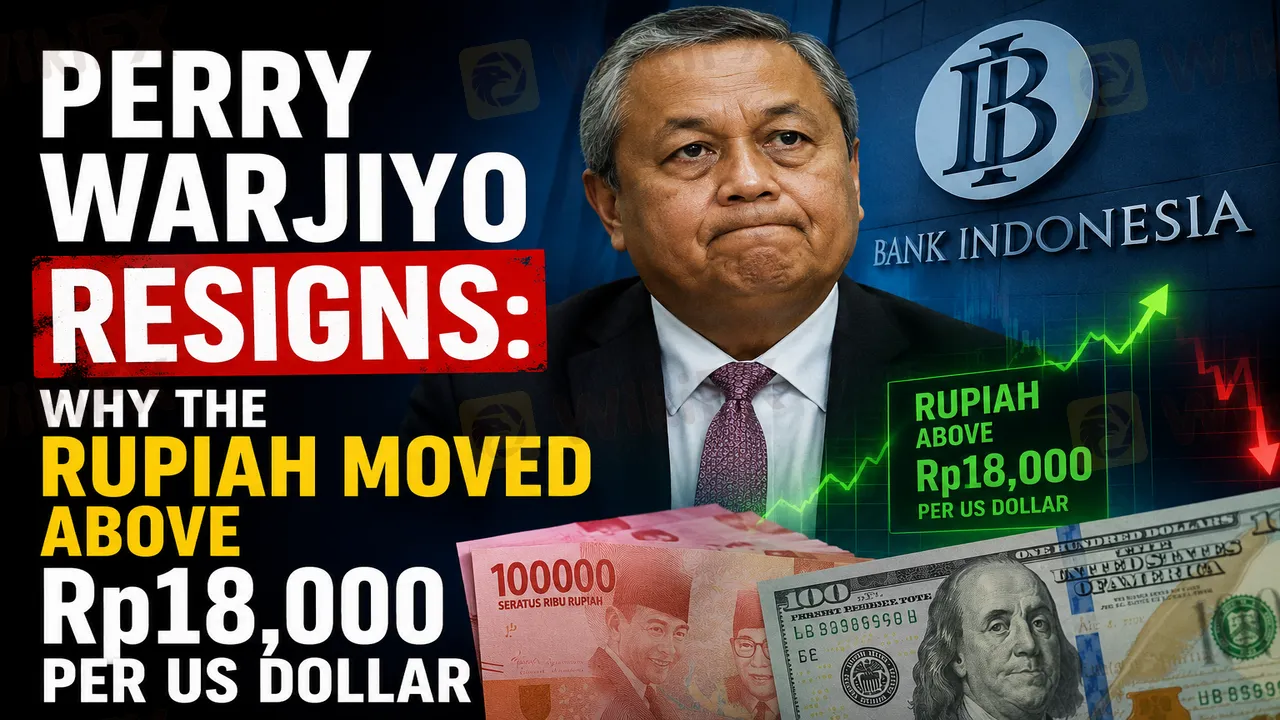
Perry Warjiyo resigned as Bank Indonesia governor, Destry Damayanti became acting governor, and the rupiah traded above Rp18,000. Here is what forex traders should monitor next.

Editorial illustration. The building, currency textures and chart lines are fictional and do not reproduce Bank Indonesia premises, personnel or market data.
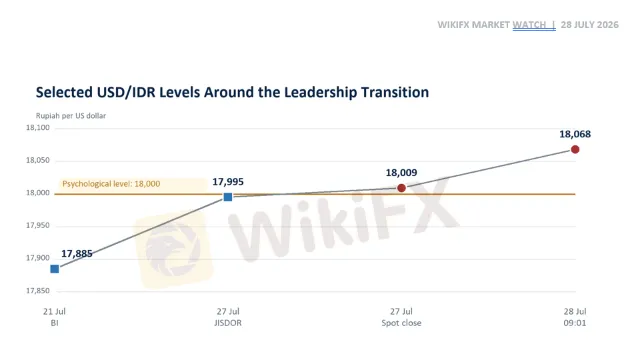
Figure 1. Selected USD/IDR observations, not a continuous price series. Sources: Bank Indonesia (21 and 27 July), KONTAN (27 July spot close), and Bloomberg Technoz (28 July at 09:01 WIB).
The Short Answer
Perry Warjiyo's unexpected exit added a new layer of uncertainty to an Indonesian rupiah that was already under pressure. The government said the resignation was voluntary and based on personal reasons. Senior Deputy Governor Destry Damayanti is now acting governor while the formal succession process moves forward.
The market reaction was visible, but it was not a collapse caused by one headline. Bank Indonesia's official JISDOR page recorded Rp17,995 per US dollar on 27 July. KONTAN reported that the spot rupiah closed at Rp18,009 the same day. On the morning of 28 July, Bloomberg Technoz reported levels of Rp18,054 at the open and Rp18,068 at 09:01 WIB.
What Happened at Bank Indonesia?
Indonesia's government formally acknowledged the resignation on 27 July. The Presidential Secretariat's statement said President Prabowo Subianto accepted Perry Warjiyo's decision and thanked him for roughly seven years of service. The official explanation was personal reasons. No further motive was established in the announcement.
ANTARA's report based on Bank Indonesia's briefing explained that the Board of Governors appointed Destry Damayanti as acting governor under the applicable legal mechanism. She will lead until a definitive governor is selected. As of the morning of 28 July, a permanent successor had not been announced.
That distinction matters. Public speculation about politics or policy disagreements should not be presented as fact without evidence. For now, the verified story is a voluntary resignation, an interim appointment, and a market waiting for clarity.
Why Did the Rupiah Move Above Rp18,000?
1. The resignation added a domestic uncertainty premium
Currency markets price confidence as well as interest rates. A surprise change at the top of a central bank can make investors reassess policy continuity, institutional independence and the timing of the next appointment. Those questions can raise the short-term risk premium on rupiah assets.
Media Indonesia's market analysis noted that the leadership change was an additional source of pressure, not the only cause. That is the more careful reading of the price action.
2. The rupiah was already facing global pressure
Six days before the resignation became public, the Bank Indonesia Board of Governors held the BI-Rate at 5.75%. The same statement said the rupiah had been pressured since late June by renewed Middle East conflict and stronger market expectations of a higher US federal funds rate.
The central bank recorded Rp17,885 per US dollar on 21 July. It also said it would continue intervention in the offshore NDF market and in domestic spot and DNDF markets. This shows that currency pressure existed before the leadership announcement.
3. Rp18,000 became a psychological level
Round numbers matter because traders, companies and the public notice them. Crossing Rp18,000 can trigger headlines and defensive positioning even when the percentage move is limited. It can also affect importer hedging, corporate dollar demand and the retail perception of currency risk.
What Bank Indonesia Has Said About Policy Continuity
Acting Governor Destry Damayanti moved quickly to calm the market. According to ANTARA's 28 July report, she said existing monetary and financial-stability policies would continue. She also said BI would remain active in spot, NDF and DNDF markets to safeguard the rupiah.
This message reduces the risk of an immediate policy vacuum. BI is governed collectively, and its operational tools do not disappear when the governor changes. The larger question is whether the transition remains orderly and whether the next appointment reinforces confidence in the institution.
An Illustrative Real-World Impact
Illustrative scenario - not a report of an actual company or customer. Imagine a small importer in Surabaya that must pay a US$50,000 invoice. At Rp17,885 per dollar, the invoice costs about Rp894.25 million. At Rp18,068, it costs about Rp903.40 million. The difference is roughly Rp9.15 million before bank fees or hedging costs.
For a leveraged retail trader, the emotional effect can be even faster. A sudden move may widen spreads, increase slippage and tempt the trader to chase the market. That is precisely when position size, stop-loss discipline and broker execution quality matter most.
What Forex Traders Should Watch Next
The succession timeline
Watch for the official nomination process, the expected timetable and statements about central-bank independence. A clear process may reduce uncertainty. A prolonged or disputed transition may keep the risk premium elevated.
BI intervention and the onshore-offshore gap
Compare JISDOR, the domestic spot market and offshore NDF pricing. A widening gap can signal stress or different expectations between local and international participants.
Global dollar and rate expectations
The US dollar, Treasury yields, Federal Reserve expectations, energy prices and Middle East developments remain important. A domestic headline can amplify a global move, but it does not replace the global backdrop.
Broker execution conditions
During volatile USD/IDR trading, verify spreads, margin requirements, stop-out rules and withdrawal procedures before increasing exposure. Check the broker's legal entity and licence independently. Do not assume that a familiar brand name guarantees the same regulated entity in every country.
Three Scenarios for the Rupiah
Stabilisation scenario
Clear succession signals, consistent BI intervention and softer global dollar pressure could help USD/IDR settle back into a more stable range.
Volatility scenario
Mixed messages or a slow appointment process could keep intraday swings elevated even if the exchange rate does not move in one direction.
Further-weakness scenario
A stronger US dollar, higher global yields, renewed geopolitical stress or doubts about domestic policy credibility could push the rupiah under additional pressure. This is a risk scenario, not a forecast.
The Bottom Line
Perry Warjiyo's resignation is important because central-bank leadership affects confidence. Yet the rupiah's move above Rp18,000 cannot be explained by the resignation alone. The currency was already dealing with global-rate expectations, geopolitical risk and domestic dollar demand.
For traders, the key is to separate verified facts from speculation. Follow the official succession process, BI's intervention signals and the global dollar backdrop. Avoid treating a politically sensitive headline as a one-way trading signal.
FAQ
Why did Perry Warjiyo resign?
The official explanation was personal reasons. No more specific verified reason was provided in the government and BI announcements reviewed for this article.
Who is leading Bank Indonesia now?
Senior Deputy Governor Destry Damayanti is acting governor until a definitive successor is appointed through the legal process.
Did the resignation alone cause the rupiah to weaken?
No. It added domestic uncertainty, but BI and market analysts had already identified global interest-rate expectations, geopolitical risk and other pressures before the announcement.
Is Rp18,000 a formal policy limit?
No. It is a widely watched psychological level, not an officially announced exchange-rate peg or guaranteed intervention threshold.
Editorial Disclaimer
This article is for information and education only. It is not investment advice, a price forecast or a recommendation to trade USD/IDR. Exchange rates can change rapidly. Readers should verify current market data and assess their own risk tolerance before making financial decisions.
Follow the WikiFX app for the latest forex updates.