Abstract:An overnight swap fee is a financing adjustment, not a simple broker charge. This guide separates the benchmark differential, the markup and the day-count basis, then shows why the quoted number can mislead beginners.

Any forex position left open past your broker's daily rollover cut-off may be adjusted by an overnight swap fee, also called rollover. The cut-off is the moment the broker closes one trading day and opens the next for financing purposes, and each broker sets its own time, usually published in the contract specifications. This adjustment is separate from the spread, which is the gap between the bid price (what buyers are currently offering) and the ask price (what sellers are asking). The spread is a transaction cost you meet when you trade in and out; the swap is a financing adjustment that depends on how long you hold.
A currency position is economically similar to borrowing one currency so you can hold another. In a pair such as EUR/USD, the first currency (EUR) is the base currency and the second (USD) is the quote currency, so the quoted price tells you how many dollars one euro costs. Buying the pair makes you long euro and short US dollar, while selling does the reverse; long simply means you own the position, short means you have sold something you did not own. The swap reflects the cost or the return of carrying that pair overnight, plus whatever adjustment the broker builds in.
 Contents
The three layers inside the quoted number
A quoted swap is rarely one clean number. It is usually built from three parts, and knowing them lets you compare brokers without being distracted by presentation.
- Benchmark funding differential: this reflects short-term interest rates and funding conditions in the two currencies. It is not simply a central bank policy rate, and it shifts as money-market conditions shift.
- Broker markup: an extra charge built into the quote. It reduces a credit or enlarges a debit, and it is often not shown as a separate line.
- Day count and conversion: annual rates are divided by a day-count basis, meaning the agreed number of days used for the year in the calculation, with 360 or 365 being common, then converted into your account currency.
A simplified one-night formula looks like this: daily swap is roughly notional multiplied by (benchmark differential minus broker markup), then divided by the day-count basis. Notional is the full face value of the position, not the deposit you set aside. That deposit is the margin, the collateral your broker requires to keep the position open, and leverage is the ratio between the two. Leverage changes the margin required but not the notional, so it does not change the swap calculation itself.
Use a positive differential when the currency you are long carries the higher benchmark rate, and a negative one when it carries the lower rate. For a short position the sign flips. Working through the order helps:
- Identify which currency you are long and which you are short, because the sign of the swap follows your direction.
- Find the benchmark differential for that pair and check whether it works as a credit or a cost on your side.
- Subtract the broker markup, which can quietly turn a small benchmark credit into a net debit.
- Divide by the day-count basis, multiply by the number of nights held, then convert into your account currency.
A hypothetical calculation, step by step
The following is a hypothetical teaching example, not a real quote and not a trade instruction. Assume an account denominated in US dollars and a purchase of one standard lot of EUR/USD at 1.1215, where a standard lot means 100,000 units of the base currency. The notional is therefore 100,000 euros, or about 112,150 US dollars at that rate. Assume a day-count basis of 360 days, an annual benchmark differential of 2.00% in favour of the euro, and a broker markup of 0.75% a year.
The benchmark credit works out as 112,150 multiplied by 2.00%, divided by 360, or about 6.23 US dollars per night. The markup is 112,150 multiplied by 0.75%, divided by 360, or about 2.34 US dollars per night. Subtracting the second from the first leaves a net credit of about 3.89 US dollars per night. The basis matters: on a 365-day count the same rates would give about 6.14 dollars instead of 6.23, so it is worth checking which basis a broker uses before comparing quotes.
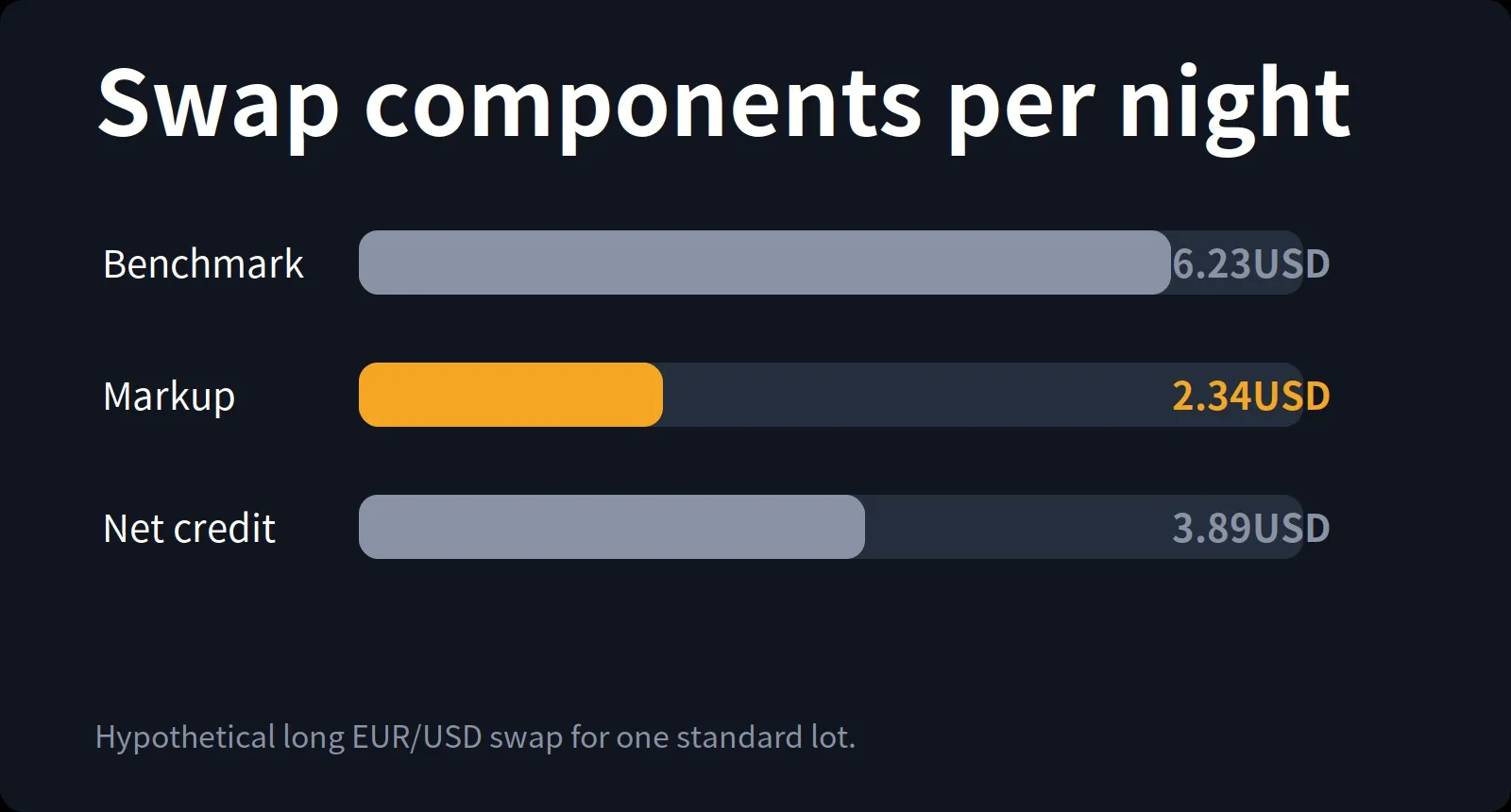
Hypothetical figures, not a real quote.
The example also shows why a positive headline rate proves little. Drop the benchmark differential to 1.00% and the credit becomes about 3.12 US dollars per night; after the same 2.34 dollar markup, the net is about 0.78 US dollars, an annual net rate of 0.25%. Drop it to 0.50% and the credit is about 1.56 US dollars, which the unchanged markup flips into a net debit of about 0.78 US dollars per night.
Where the quoted number gets murky
Transparency problems usually come from presentation rather than arithmetic. A swap that looks tiny as a rate can become significant once it is multiplied by a large notional and many nights.
- Points versus account currency: some brokers quote swap in points, where a point (often called a pip) is a standardised price increment, commonly the fourth decimal place for most pairs, while others quote a cash amount in your account currency. The two are not comparable until you convert them.
- Where the markup sits: the broker charge may be inside the quoted rate or added as a separate financing line. Compare the all-in cost, not the headline differential.
- Triple swap days: many brokers apply a triple charge on one weekday to cover the weekend settlement gap, the extra days when interbank settlement does not take place. That weekday differs by broker, so holding over one night is not always one night of swap.
- Rates that move: swap quotes reset as funding conditions change. A number you saw today is not fixed for the life of the position.
- Account currency: if your account is not in the quote currency, conversion can add to or trim the final amount.
Beginners also misread what the fee means. A position opened only hours earlier can still attract swap if it remains open across the cut-off, so this is not only a long-term cost. A positive swap is not free money either, because price movement can easily outweigh a small nightly credit. The useful question is never whether the swap looks favourable on its own, but how it sits alongside spread, price movement, and the time you actually intend to hold.
Finally, WikiFX would like to remind everyone that before using any US stock, futures, or forex brokers, remember to check the platform's regulatory information, trading environment, field inspection reports, user reviews, and overall rating on the WikiFX App. This will help you effectively avoid problematic scam platforms and rogue brokers, safeguarding your capital.