

Global Broker Regulation Inquiry App
About WikiFX
English
简体中文
繁體中文
English
Pусский
日本語
ภาษาไทย
Tiếng Việt
Bahasa Indonesia
Español
हिन्दी
Filippiiniläinen
Français
Deutsch
Português
Türkçe
한국어
العربية
اردو


Is Your Withdrawal Plan Killing Your Compounding Gains?

WikiFX
|


Abstract:Fixed monthly withdrawals can quietly undermine compounding by removing capital regardless of performance. A stepwise withdrawal plan tied to new equity highs helps preserve the compounding base. Learn how with a clear hypothetical example.

 Contents
What Is Withdrawal Planning and Why Timing Matters?
Withdrawal planning decides when and how much you take out of a trading account. It is not just about having cash on hand; it directly affects account growth. Many beginners think a fixed monthly withdrawal is safe and simple. After all, a predictable income stream from trading feels reassuring. Yet that routine can quietly undermine compounding, the engine that grows your money.
Compounding means earning returns on previous returns. Every ringgit you leave in the account works to generate more ringgit next month. When you withdraw on a calendar schedule, you remove some of that working capital. Worse, you may withdraw after a losing month, locking in losses and shrinking the base that will compound later. Timing matters more than most new traders realise.
A better plan ties withdrawals to your equity curve, a graph of your account balance over time. Instead of a date, you use a performance-based rule: take money out only when the account has actually made new highs. This preserves your compounding core. The rest of this article explains why fixed monthly withdrawals disrupt compounding and how a stepwise new-highs approach provides a disciplined alternative.
The Power of Compounding and the Fixed-Withdrawal Trap
Compounding works best when the capital base is left untouched. In a simplified model, an initial RM10,000 earning a consistent 5% monthly would grow to roughly RM17,959 after 12 months with no withdrawals. Fixed withdrawals slash that growth because they permanently remove capital, even after down months.
Fixed monthly withdrawals create two problems. First, you take money out regardless of whether the account grew. A flat or losing month means the withdrawal reduces the base, requiring an even larger percentage gain just to recover. Second, the same withdrawal amount punches harder when the account is smaller. A RM500 withdrawal from a RM9,000 balance shaves off 5.6% of capital, while from RM20,000 it is only 2.5%.
The trap deepens if you rely on those regular withdrawals for living expenses. You may feel forced to maintain the fixed amount during drawdowns, draining the account faster than it can recover. A sounder method takes profits only after genuine progress: a new equity high.
Building a Withdrawal SOP Around Stepwise Equity Highs
A stepwise new-highs plan works like this: track your all-time peak equity and withdraw only when the current balance exceeds that peak. Take just a fraction of the surplus, leaving the rest to compound. During drawdowns, you make no withdrawals.
Here is a hypothetical five-month simulation comparing the two approaches. Both traders start with RM10,000 and face the same monthly returns: +5%, +3%, −2%, +8%, +4%.
- Trader A uses a fixed RM500 monthly withdrawal.
- Trader B uses a stepwise rule: withdraw 25% of profit above the last peak, only after a new high.
Month 1 (+5%): Balance becomes RM10500. Trader A withdraws RM500, ending at RM10000. Trader B records a new high (previous peak RM10000), profit RM500, withdraws RM125 (25%), balance RM10375. New peak: RM10375.
Month 2 (+3%): Trader A's balance grows to RM10300, then −RM500 → RM9800. Trader B's balance rises to RM10686.25, a new high above RM10375, surplus RM311.25. Withdraws RM77.81, balance RM10608.44. New peak: RM10608.44.
Month 3 (−2%): Trader A falls to RM9604, then −RM500 → RM9104. Trader B dips to RM10396.27 (no new high), so no withdrawal.
Month 4 (+8%): Trader A climbs to RM9832.32, −RM500 → RM9332.32. Trader B reaches RM11227.97, new high above RM10608.44, surplus RM619.53. Withdraws RM154.88, balance RM11073.09. New peak: RM11073.09.
Month 5 (+4%): Trader A ends at RM9205.61 after −RM500. Trader B grows to RM11516.01, surplus RM442.92, withdraws RM110.73, final balance RM11405.28.
After identical market moves, Trader A's account shrank to 9205.61 ringgit, while Trader B's grew to 11405.28 ringgit. The stepwise rule kept more capital working and recovered faster from the losing month.
You can adapt this into a personal standard operating procedure:
- Record your starting peak equity.
- At the end of each checking period, compare the balance to the peak.
- If it is higher, take a pre-set fraction (e.g., 20–30%) of the surplus only.
- Update the peak to the post-withdrawal balance.
- If the balance is below the peak, skip the withdrawal.
This framework ensures you only take profits when the account is truly at a higher level, not simply because a date arrived.
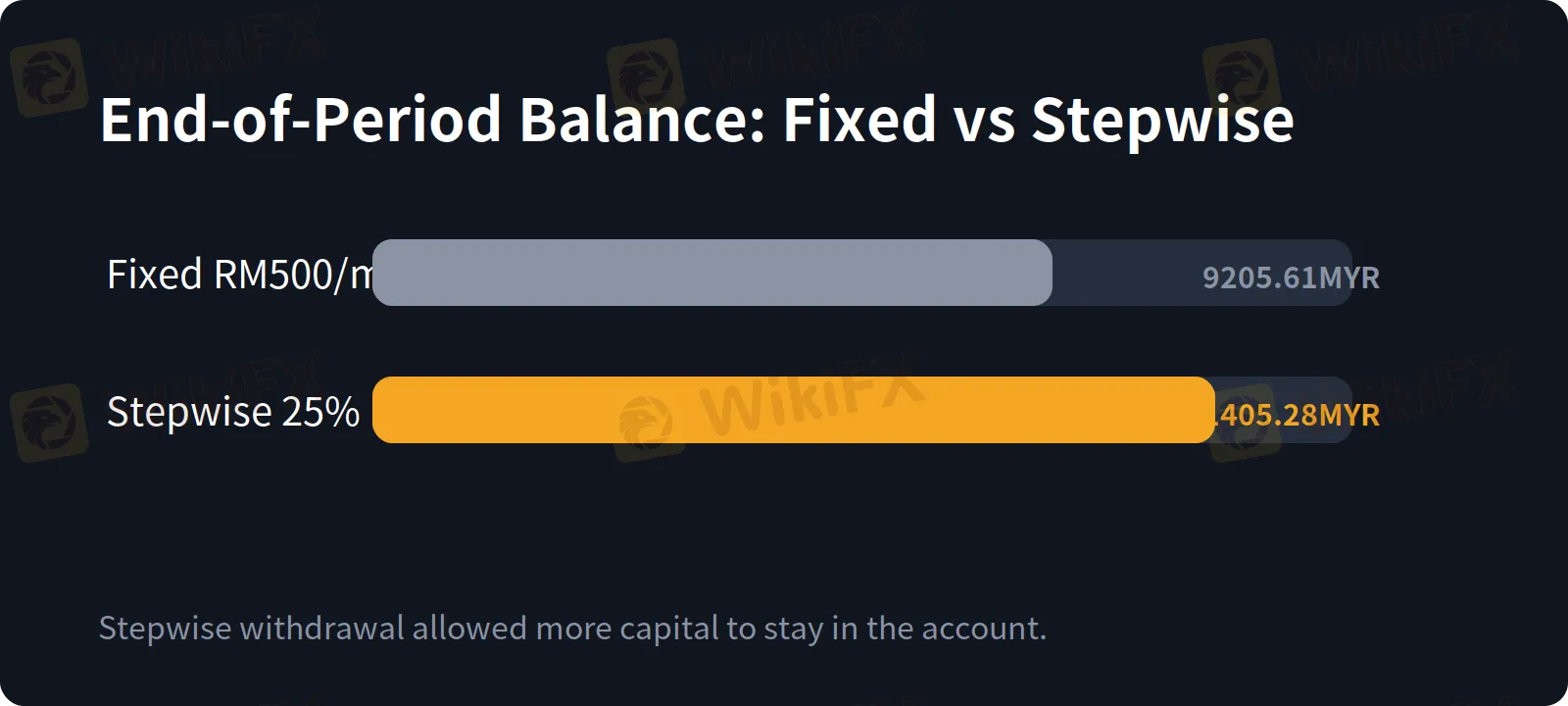
Hypothetical 5-month simulation starting at RM10,000. Not indicative of actual trading results.
Common Misconceptions and Limitations
A stepwise withdrawal plan is a capital-management tool, not a magic formula. If your strategy loses money over time, no withdrawal rule can rescue it. The rule merely helps avoid pulling cash out at the worst moments.
New traders sometimes think they should withdraw all profits above the peak to “lock in” gains. That halts compounding entirely. The fraction you leave in the account is what fuels growth: withdrawing over 50% of the surplus can seriously slow it down.
Psychologically, watching your account hit a new high and then give back some gains without taking cash can feel painful. But that discipline lets the balance ride through normal volatility and compound over the long run. The stepwise rule removes emotional decisions at market tops.
This approach is not for everyone. If trading income is your primary monthly budget, you might blend a small fixed withdrawal with a performance-based top-up. The crucial insight is that fixed withdrawals and compounding conflict. Compounding demands capital stay invested; every withdrawal cuts future growth.
All withdrawal planning boils down to a simple truth: when you take money out shapes how fast your account grows. A stepwise, new-highs-based plan protects your compounding engine without needing a crystal ball. It is a disciplined system that treats withdrawals as part of a growth-focused strategy.
Disclaimer:
The views in this article only represent the author's personal views, and do not constitute investment advice on this platform. This platform does not guarantee the accuracy, completeness and timeliness of the information in the article, and will not be liable for any loss caused by the use of or reliance on the information in the article.
WikiFX Broker
Latest News
EUR/USD: Bearish Structure Shift
WikiFXKudotrade Review 2026: Reported Slippage & Trade Execution Issues You Should Know
WikiFXEURUSD | Demand Zone Holding, Bulls Eyeing Higher Resistance
WikiFXFxPro Opens Five CFDs To Weekend Trading
WikiFXSEC Alleges $16 Million Ponzi Scheme Targeted 200 Investors
WikiFXValutrades Rejects Exit Rumors Amid Client Review
WikiFXMalaysia To Host Asia Fintech Regulatory Summit
WikiFXIG Faces Hundreds Of Job Cuts In Global Restructure
WikiFX1MDB Recovery Still Leaves RM20 Billion Burden
WikiFXWhy Are Retail CFD Brokers Searching Beyond Traditional FX Trading?
WikiFX