Abstract:The disposition effect is the habit of closing winners quickly while giving losers more time and hope. This piece explains the loss aversion, mental accounting, regret avoidance and anchoring behind it, walks through a clearly hypothetical pip example anchored to the reference quote shown, and describes what a simple trading journal tends to reveal about the pattern.
A position is simply a trade you have already entered and have not yet closed. Yours is finally in profit, the number on the screen is small but real, and your hand drifts toward the close button before you have decided anything. An hour later the same pair, meaning the two currencies your trade is priced in, is moving against you, and closing now looks like the wrong idea. Your personality did not change in between. Only the side of the trade that is losing changed.
 Contents
Why a winning trade feels finished early
Closing a position at a profit is usually called taking profit, and closing one at a loss is called cutting a loss. Many traders write both rules down in advance, yet the two actions feel nothing alike once real money is on the screen.
- A profit feels like something that can be protected, because closing turns an uncertain gain into a settled one.
- A loss feels like something that can be undone, because closing turns a bad moment into a recorded mistake.
- The result is uneven treatment: small wins get banked quickly, while losses are handed more time, more hope and more explanations.
Behavioural finance, the branch of economics that studies how people actually choose rather than how theory says they should, has a name for that uneven treatment: the disposition effect. It describes the tendency to sell winners too early and hold losers too long, and it shows up across many markets, not only in currency trading.
The machinery behind the habit
Loss aversion is the first piece of the machinery. It is the finding, repeated across many studies of choice, that a loss of a given size tends to be felt more sharply than a gain of the same size is enjoyed. Prospect theory, the framework describing how people weigh gains against losses, treats this as an ordinary feature of deciding under uncertainty rather than a character defect. Knowing its name does not switch it off.
- Loss aversion: the same amount of money stings more when it is lost than it pleases when it is won.
- Mental accounting: each open position becomes a small separate account, and the wish is for that account to finish in profit.
- Regret avoidance: an unrealised loss, meaning one that exists only on paper until the position is closed, is still a possibility, while a realised loss is a fact with a date on it.
- Anchoring on entry: the entry price, the price at which you opened, becomes the reference point, so trading above it feels like winning even when the wider picture disagrees.
Put those four together and the loop almost writes itself.
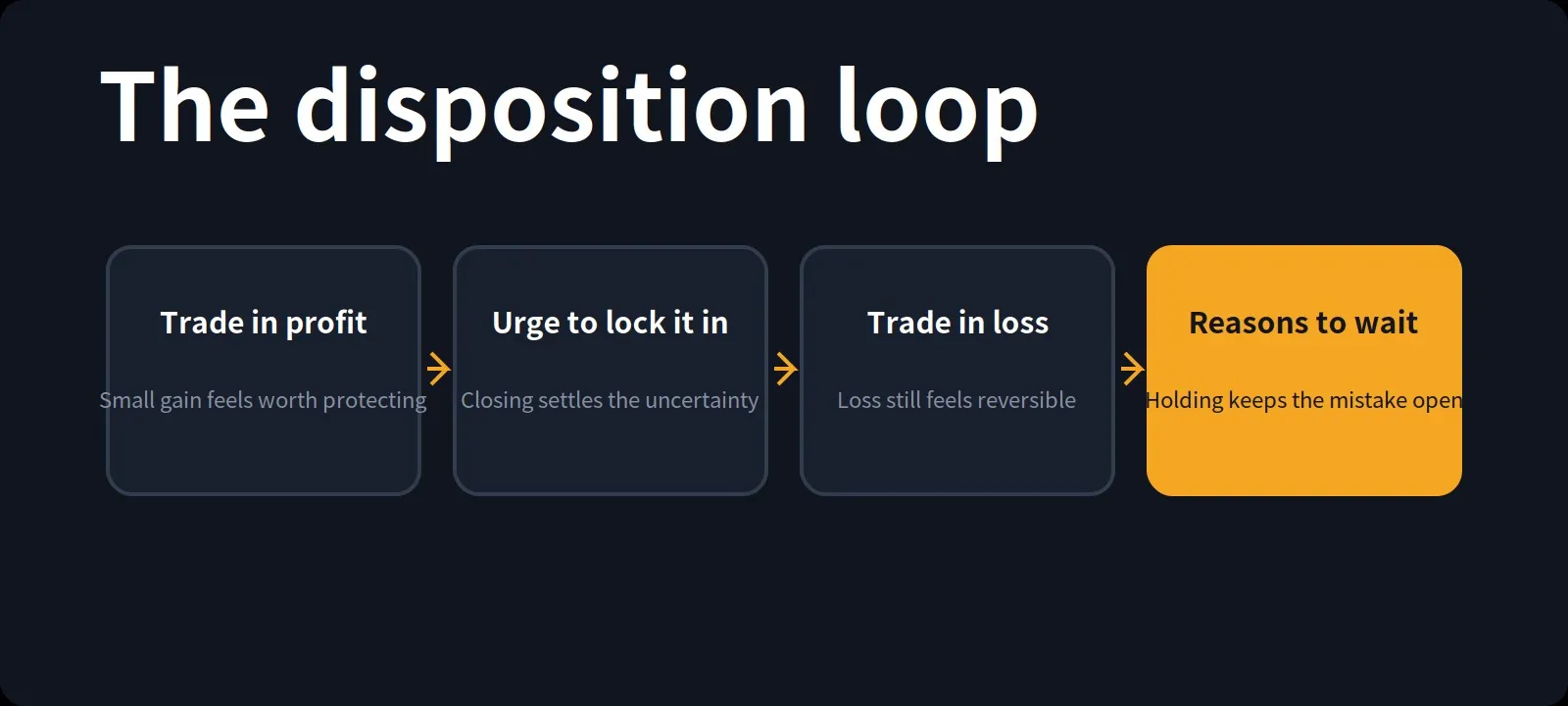
The same trader, two very different reactions.
A hypothetical position, with the arithmetic shown
Everything in this section is invented for teaching. Assume EUR/USD, the number of US dollars that one euro buys, is quoted near 1.1215, matching the reference quote used for this article, and that a hypothetical position is opened at that price. For this pair one pip, the standard unit for counting small price moves, is 0.0001, so a move of 0.0040 is 40 pips. Nothing here is a real trade, a recommendation or an instruction to act.
- Scenario one: price rises 40 pips to 1.1255 and the position is closed quickly, so the realised gain is 40 pips.
- Scenario two: price falls 60 pips to 1.1155 and the position stays open, so the loss remains unrealised, which makes it feel temporary.
The useful part is the shape of the record rather than the numbers. A closed win of 40 pips against an open loss of 60 pips means the winning trade has to repeat more often than the losing one for the account to stand still, even before the spread, the gap between the buying and selling price, is counted.
What makes the pattern stubborn is that holding does not register as a decision. It registers as patience, or as waiting for the market to come back.
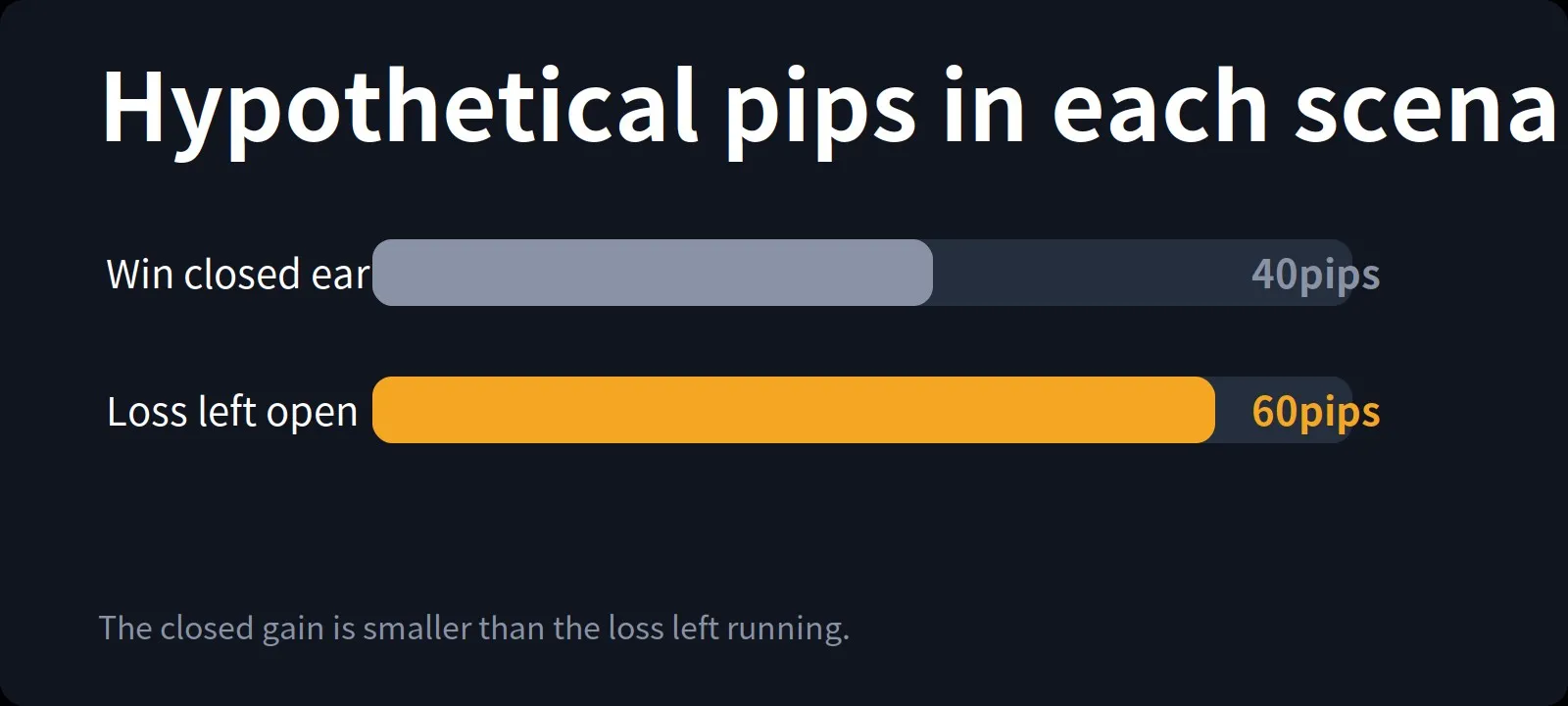
Invented numbers, used only to show the shape of the record.
What a trading record reveals
A journal tends to work better than willpower here, because it records behaviour instead of intentions. Traders who keep one describe the same handful of entries, and none of them involves forecasting the market.
- Before a position exists, the reason for the idea and the condition that would show it wrong, written in the trader's own words.
- While the position is open, the small behaviours that show up: refreshing the chart, collecting more opinions, recalculating the same figures.
- After it closes, how long it was held and whether it ended in profit or loss.
- Once a month, the average win in pips set beside the average loss, and the average holding time of winners set beside that of losers.
Those four lines tend to be more honest than memory. Where winners are routinely held for less time than losers, the disposition effect is present in the record, whatever the trader believed about themselves. A neutral question, asked in the third person, sometimes helps: at the current price, knowing only what is known now, would this position be opened from scratch?
Naming the pattern does not remove it. What changes is that the choice becomes visible while it is happening, which feels different from repeating a habit that has no name.